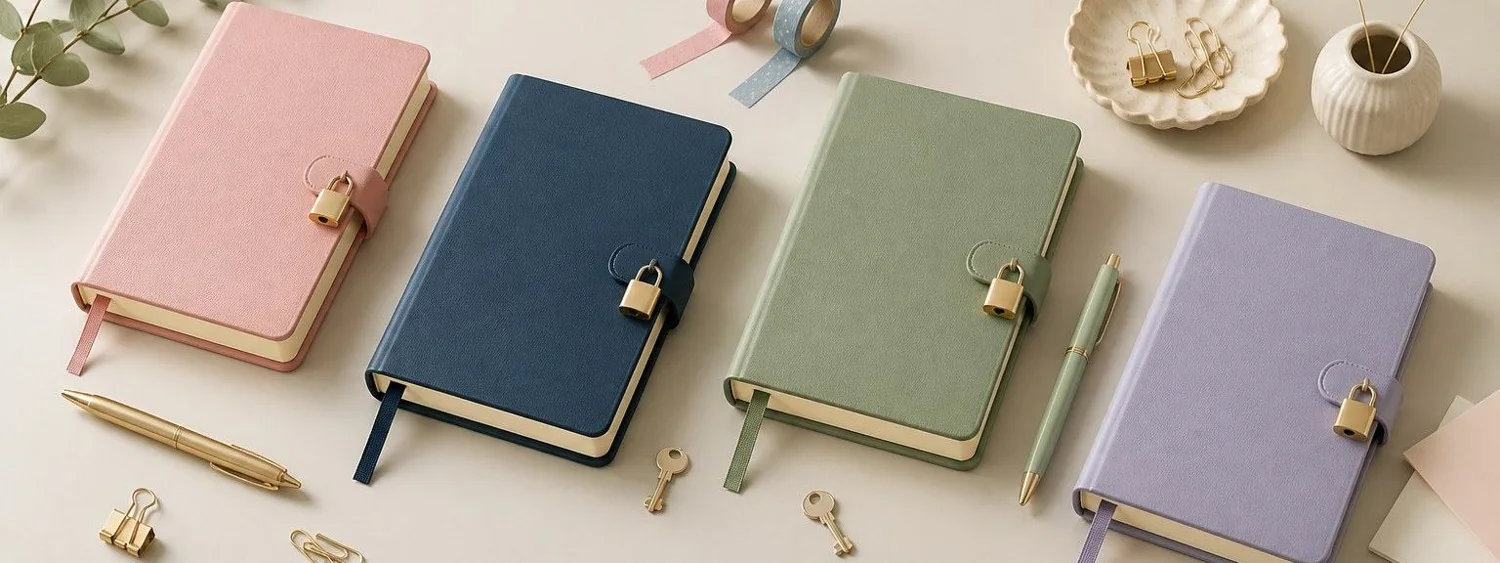
This support page focuses on lock types, keys, codes, and real privacy for locked diary journals. Product comparisons belong on 7 Best Diary Journal With A Lock. Previous cloud article: book lights for reading in the dark.
Lock Types, Keys, Codes, and Real Privacy
Practical lens. A lock on a diary is a boundary signal first and a security feature second. Compare simple key locks, combination clasps, magnetic closures, and strap designs by how reliably they stay shut in a drawer, backpack, bedside table, or school locker.
Privacy expectation. Treat the lock as light deterrence, not a safe. It should discourage casual reading while still being easy for the writer to open without frustration. For lock types, keys, codes, and real privacy, this criterion keeps the choice grounded in real journaling behavior instead of decorative product photos alone.
Page experience. Check paper weight, ruling, page count, lay-flat behavior, and whether common pens ghost or bleed through during emotional, fast, or long-form writing. For lock types, keys, codes, and real privacy, this criterion keeps the choice grounded in real journaling behavior instead of decorative product photos alone.
Daily handling. A good diary survives backpacks, bedside drawers, travel, school desks, and repeated opening without loose hinges, torn straps, or bent keys. For lock types, keys, codes, and real privacy, this criterion keeps the choice grounded in real journaling behavior instead of decorative product photos alone.
Style and identity. Colors, cover texture, charms, prompts, and decorative details matter because people write more consistently in a journal that feels like theirs. For lock types, keys, codes, and real privacy, this criterion keeps the choice grounded in real journaling behavior instead of decorative product photos alone.
Storage habits. The lock only helps when the diary has a sensible home: a drawer, shelf, bag pocket, or desk spot that is private but not so hidden that writing stops. For lock types, keys, codes, and real privacy, this criterion keeps the choice grounded in real journaling behavior instead of decorative product photos alone.
Value signals. Look for clear product photos, honest dimensions, spare key information, warranty language, and reviews that mention months of real writing rather than only gift-day impressions. For lock types, keys, codes, and real privacy, this criterion keeps the choice grounded in real journaling behavior instead of decorative product photos alone.
Decision note. Choose the diary that makes private writing feel safe, reachable, and pleasant. If the lock, paper, cover, and storage routine all support the same habit, the journal is more likely to be used after the first excited week.
Private-writing checklist
Practical lens. A lock on a diary is a boundary signal first and a security feature second. Compare simple key locks, combination clasps, magnetic closures, and strap designs by how reliably they stay shut in a drawer, backpack, bedside table, or school locker.
Privacy expectation. Treat the lock as light deterrence, not a safe. It should discourage casual reading while still being easy for the writer to open without frustration. For buyer checklist for lock types, keys, codes, and real privacy, this criterion keeps the choice grounded in real journaling behavior instead of decorative product photos alone.
Page experience. Check paper weight, ruling, page count, lay-flat behavior, and whether common pens ghost or bleed through during emotional, fast, or long-form writing. For buyer checklist for lock types, keys, codes, and real privacy, this criterion keeps the choice grounded in real journaling behavior instead of decorative product photos alone.
Daily handling. A good diary survives backpacks, bedside drawers, travel, school desks, and repeated opening without loose hinges, torn straps, or bent keys. For buyer checklist for lock types, keys, codes, and real privacy, this criterion keeps the choice grounded in real journaling behavior instead of decorative product photos alone.
Style and identity. Colors, cover texture, charms, prompts, and decorative details matter because people write more consistently in a journal that feels like theirs. For buyer checklist for lock types, keys, codes, and real privacy, this criterion keeps the choice grounded in real journaling behavior instead of decorative product photos alone.
Storage habits. The lock only helps when the diary has a sensible home: a drawer, shelf, bag pocket, or desk spot that is private but not so hidden that writing stops. For buyer checklist for lock types, keys, codes, and real privacy, this criterion keeps the choice grounded in real journaling behavior instead of decorative product photos alone.
Value signals. Look for clear product photos, honest dimensions, spare key information, warranty language, and reviews that mention months of real writing rather than only gift-day impressions. For buyer checklist for lock types, keys, codes, and real privacy, this criterion keeps the choice grounded in real journaling behavior instead of decorative product photos alone.
Decision note. Choose the diary that makes private writing feel safe, reachable, and pleasant. If the lock, paper, cover, and storage routine all support the same habit, the journal is more likely to be used after the first excited week.
Real-use rehearsal
Practical lens. A lock on a diary is a boundary signal first and a security feature second. Compare simple key locks, combination clasps, magnetic closures, and strap designs by how reliably they stay shut in a drawer, backpack, bedside table, or school locker.
Privacy expectation. Treat the lock as light deterrence, not a safe. It should discourage casual reading while still being easy for the writer to open without frustration. For daily writing rehearsal for lock types, keys, codes, and real privacy, this criterion keeps the choice grounded in real journaling behavior instead of decorative product photos alone.
Page experience. Check paper weight, ruling, page count, lay-flat behavior, and whether common pens ghost or bleed through during emotional, fast, or long-form writing. For daily writing rehearsal for lock types, keys, codes, and real privacy, this criterion keeps the choice grounded in real journaling behavior instead of decorative product photos alone.
Daily handling. A good diary survives backpacks, bedside drawers, travel, school desks, and repeated opening without loose hinges, torn straps, or bent keys. For daily writing rehearsal for lock types, keys, codes, and real privacy, this criterion keeps the choice grounded in real journaling behavior instead of decorative product photos alone.
Style and identity. Colors, cover texture, charms, prompts, and decorative details matter because people write more consistently in a journal that feels like theirs. For daily writing rehearsal for lock types, keys, codes, and real privacy, this criterion keeps the choice grounded in real journaling behavior instead of decorative product photos alone.
Storage habits. The lock only helps when the diary has a sensible home: a drawer, shelf, bag pocket, or desk spot that is private but not so hidden that writing stops. For daily writing rehearsal for lock types, keys, codes, and real privacy, this criterion keeps the choice grounded in real journaling behavior instead of decorative product photos alone.
Value signals. Look for clear product photos, honest dimensions, spare key information, warranty language, and reviews that mention months of real writing rather than only gift-day impressions. For daily writing rehearsal for lock types, keys, codes, and real privacy, this criterion keeps the choice grounded in real journaling behavior instead of decorative product photos alone.
Decision note. Choose the diary that makes private writing feel safe, reachable, and pleasant. If the lock, paper, cover, and storage routine all support the same habit, the journal is more likely to be used after the first excited week.
Final fit buffer
Also test the diary against the real places it may live: a nightstand drawer, backpack pocket, school locker, dorm shelf, desk organizer, suitcase, or keepsake box. A journal that looks beautiful on a product page can still fail if the key snags, the clasp opens in a bag, or the size makes it awkward to reach for when thoughts arrive quickly.
For young writers, teens, adults, or gift recipients, think about emotional comfort as much as physical construction. The diary should feel private without feeling childish, serious without feeling intimidating, and sturdy enough that the owner trusts it with messy handwriting, lists, worries, gratitude notes, memories, and ideas that are still forming.
Finally, compare the lock with the writing habit. A tiny key may feel charming but can be lost; a combination lock avoids keys but needs numbers the owner remembers; a strap closure looks classic but may be easier to pry. The right compromise is the one that protects against casual snooping while keeping the journal easy enough to open every day.
Check the backup plan too: where the spare key goes, whether the manufacturer explains resets, how the cover handles scuffs, and whether replacement is possible if the diary becomes a long-term habit. These details decide whether the journal feels dependable after weeks of real private writing.
As a last pass, picture the owner on an ordinary tired evening. The diary should be easy to find, comfortable to open, private enough to trust, and pleasant enough that a short entry still feels worthwhile. If any design detail makes that moment fussy, the journal may become decoration instead of a dependable place for real thoughts.
When the privacy level and writing routine are clear, compare the full locked-diary shortlist here: 7 Best Diary Journal With A Lock.